AI Onboarding Tools: How to Train Teams Faster on New Software

New software is constantly being introduced across teams. But onboarding employees to new tools still often relies on long documentation, generic training sessions, and manual support.
Employees often forget traditional onboarding materials because support is separated from the actual tools and workflows they use every day.
AI onboarding tools help companies automate and personalize employee training, making it easier for teams to learn new software faster. Instead of relying on static guides, AI-powered onboarding delivers interactive, role-based support directly in the flow of work.
The result is faster time-to-productivity, fewer repetitive questions for HR and IT teams, and a smoother onboarding experience for employees.
In this guide, we’ll break down what AI onboarding is, how AI-powered onboarding platforms work, and which best practices help teams adopt new tools more efficiently.
The evolution of onboarding: From paperwork to AI
Traditional employee onboarding has long been built around manuals, presentations, checklists, and one-time training sessions. Even after onboarding became digital, many companies still relied on static documentation and generic learning paths that didn’t adapt to different roles or experience levels.
Today, teams are expected to learn new software faster than ever, especially in remote and hybrid work environments where real-time support is limited. As companies adopt more tools across departments, traditional onboarding methods often struggle to keep up.
Several factors are driving the shift toward AI-powered onboarding:
- faster software rollouts across organizations
- shorter software adoption cycles and constant process changes
- remote and distributed teams that need consistent training
- growing expectations for interactive learning experiences
- pressure to improve software adoption and ROI faster
AI onboarding tools help solve these challenges by personalizing training, automating repetitive onboarding tasks, and delivering guidance based on employee progress and behavior.
As a result, companies can reduce time-to-productivity, improve onboarding consistency, and help employees feel confident using new tools much sooner.
Core benefits of AI onboarding for teams
AI onboarding helps teams learn new tools faster while improving consistency across the onboarding process, especially for growing or distributed teams.
- Faster time-to-productivity: employees get guided support directly inside workflows instead of relying only on long documentation or scheduled training sessions.
- Personalized learning experiences: onboarding content can adapt based on role, experience level, and employee progress.
- Better consistency and compliance: every team member receives the same core onboarding information while still allowing flexibility for different workflows.
- Scalable employee training: onboard small teams or entire organizations without creating additional pressure for HR and IT teams.
- Higher engagement and retention: interactive guidance and shorter learning modules help employees retain information more effectively.
Learn how Guideless helps teams create AI-powered onboarding experiences directly in the flow of work.
How AI transforms the team onboarding journey
AI onboarding tools improve onboarding by automating repetitive tasks, personalizing employee training, and providing support directly inside the tools teams use every day.
Automating administrative tasks
One of the biggest onboarding bottlenecks is manual setup. Creating accounts, assigning permissions, approving requests, and sharing resources can slow down the onboarding process significantly.
AI-powered automation helps reduce these delays by streamlining repetitive tasks and workflows. For example, identity management platforms like Okta can automate user provisioning, while workflow tools like ServiceNow help route approvals and onboarding tasks automatically.
This reduces administrative workload for HR and IT teams while helping employees get access to the tools they need faster.
Personalized learning and adaptive training
Not every employee learns at the same pace or starts with the same level of experience. AI onboarding platforms can adjust training content based on role, skill level, progress, or previous interactions.
Many companies combine onboarding workflows with learning platforms such as Docebo, Cornerstone OnDemand, or TalentLMS to deliver more structured employee training experiences.
Common approaches include:
- Micro-learning with shorter step-by-step lessons
- Spaced repetition to reinforce important concepts over time
- Behavior-based guidance triggered by employee actions
Intelligent knowledge access and support
Even well-designed onboarding programs can’t answer every question employees encounter during day-to-day work.
AI-powered support tools help teams find answers faster by surfacing relevant documentation, tutorials, or support resources exactly when they’re needed. Companies often integrate communication and support platforms like Intercom and Zendesk to reduce onboarding friction and improve self-service support.
This kind of just-in-time guidance helps employees stay productive without constantly relying on managers or IT teams for help.
Improving engagement and team connection
Successful onboarding is not only about learning software. It also helps employees feel connected to their team, workflows, and company culture.
AI onboarding workflows can automate check-ins, remind managers to follow up at the right moments, and help distributed teams stay aligned during the onboarding process.
Overcoming onboarding challenges with AI
Many companies face the same onboarding challenges when introducing new tools and processes across teams. AI onboarding tools help reduce friction by making training more adaptive, automated, and easier to manage at scale.
Some of the most common onboarding challenges include:
- Slow approvals and setup: automated workflows help reduce delays caused by manual provisioning, access requests, and repetitive administrative tasks.
- Generic training experiences: AI-powered onboarding can personalize learning paths based on role, experience level, and employee progress.
- Disconnected systems and inconsistent data: integrated onboarding workflows help reduce duplicate work, missing information, and manual errors.
- Limited visibility into onboarding progress: onboarding analytics can highlight drop-off points, knowledge gaps, and areas where employees may need additional support.
- Information overload: shorter, interactive onboarding experiences are often easier to follow and retain than large amounts of static documentation shared all at once.
Instead of overwhelming employees with static documentation and one-time training sessions, AI onboarding creates a more guided and continuous learning experience.
Best practices for smarter, AI-enabled team training
Successful AI onboarding is not only about choosing the right tools. It also depends on how onboarding workflows are designed, measured, and continuously improved over time.
Some best practices that help teams get better onboarding results include:
- Audit your current onboarding workflow: identify repetitive tasks, bottlenecks, approval delays, and areas where employees typically get stuck.
- Define clear onboarding success metrics: track metrics such as time-to-productivity, onboarding completion rates, support ticket volume, employee confidence, and software adoption.
- Start with a pilot rollout: testing AI onboarding with one team or department first makes it easier to identify gaps before scaling company-wide.
- Use onboarding data to improve training: engagement insights and onboarding analytics can help refine training content, timing, and support experiences over time.
- Keep the human element in the process: managers and team leads still play an important role in coaching, reinforcing learning, and helping employees feel supported during onboarding.
The most effective AI onboarding experiences combine automation with human guidance, creating a training process that feels both scalable and personal.
Examples of AI onboarding tools teams use today
Most organizations use multiple onboarding tools together, with each platform supporting a different part of the employee onboarding and software adoption process.
Some of the most common categories include:
- Digital adoption and in-app guidance: WalkMe, Whatfix, Pendo
- Product onboarding platforms: Appcues, Userpilot
- Knowledge bases and internal documentation: Notion, Confluence, Guru
- Process documentation and micro-training tools: Guideless, Scribe, Loom
- Support and employee communication tools: Intercom, Zendesk
- Learning management systems (LMS): Docebo, Cornerstone OnDemand, TalentLMS
The most effective onboarding stacks support employees directly in the flow of work, helping teams learn new tools without constantly switching between documentation, training sessions, and support channels.
Guideless: AI onboarding in the flow of work
The most effective onboarding happens inside the tools employees already use every day, not in separate training sessions or long documentation that’s easy to forget.
Guideless helps teams create AI-powered onboarding experiences that guide employees step by step directly inside workflows. Instead of searching through static documentation or waiting for support, employees get contextual guidance exactly when they need it.
Unlike static documentation or one-time training videos, Guideless helps teams deliver interactive onboarding directly inside workflows.
Teams can use Guideless to create interactive walkthroughs, process documentation, onboarding flows, and training content designed to improve software adoption across the organization.
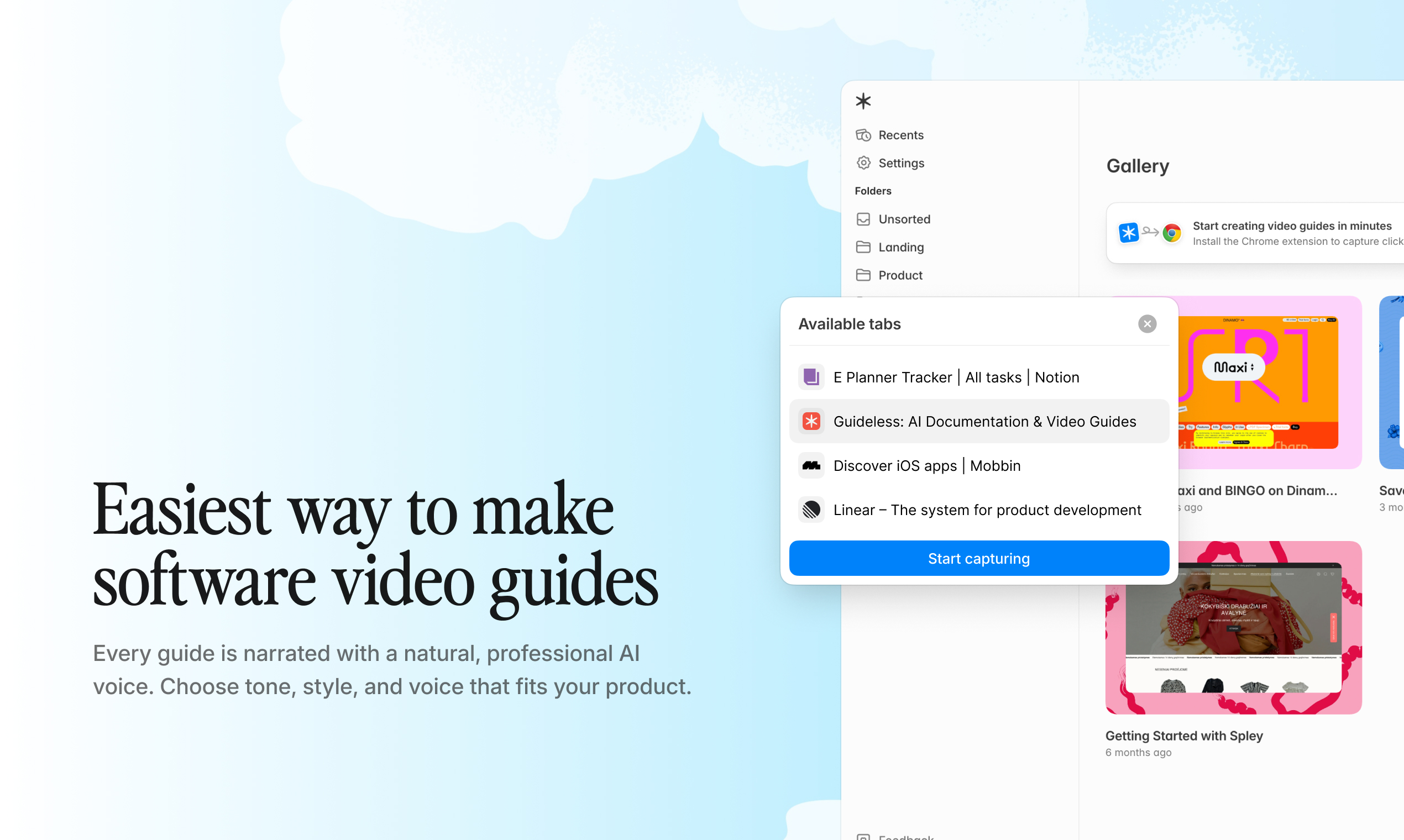
Because onboarding happens in the flow of work, employees can learn faster while staying productive, reducing the learning curve that often comes with new tools and changing processes.
Explore Guideless to see how AI-powered walkthroughs, onboarding automation, and interactive onboarding experiences can help teams adopt new tools faster.
Security, compliance, and ethical considerations in AI onboarding
AI onboarding should not only improve speed and efficiency. It also needs to meet security, compliance, and employee trust requirements across the organization.
When evaluating AI onboarding tools and workflows, companies should focus on a few key areas:
- Privacy and security: verify how onboarding platforms handle encryption, user permissions, data retention, and compliance standards such as GDPR, CCPA, SOC 2, and ISO 27001.
- Transparency around AI usage: employees should clearly understand when they are interacting with AI-powered systems versus human support.
- Bias and fairness monitoring: regularly review personalization and onboarding recommendations to help prevent unequal learning experiences or gaps in support.
- Governance and oversight: HR, IT, legal, and security teams should align on onboarding policies, escalation processes, and responsible AI usage.
As AI onboarding becomes more common, organizations that balance automation with security, transparency, and human oversight will build more sustainable and trusted onboarding experiences.
The future of AI onboarding: Trends and what's next
AI onboarding is continuing to evolve as companies look for faster, more personalized ways to support employee training and software adoption.
Some of the biggest trends shaping the future of AI-powered onboarding include:
- Predictive onboarding support: AI systems will increasingly identify where employees may struggle and proactively deliver additional guidance before problems slow productivity.
- Continuous onboarding and ongoing enablement: onboarding is shifting from a one-time process to continuous learning that supports employees as tools, workflows, and responsibilities evolve.
- More accessible and inclusive training experiences: localization, accessibility features, multilingual support, and adaptive learning experiences are becoming standard expectations for modern onboarding platforms.
- Deeper workflow integrations: onboarding guidance is increasingly being delivered directly inside the tools employees use every day, reducing context switching and improving knowledge retention.
As AI onboarding platforms continue to improve, companies will focus less on static training materials and more on interactive, contextual learning experiences that adapt in real time.
Conclusion
AI onboarding helps organizations train employees faster by automating repetitive onboarding tasks, personalizing learning experiences, and delivering support directly in the flow of work.
Companies that combine AI-powered onboarding with strong onboarding strategy, clear success metrics, and human support can improve software adoption while creating a smoother employee experience.
Explore Guideless to see how AI-powered walkthroughs and interactive onboarding experiences can help teams adopt new tools faster.
Frequently asked questions
How does AI speed up the onboarding process for new tools or software?
AI onboarding tools help automate repetitive onboarding tasks such as account setup, training delivery, and employee guidance. They also provide personalized onboarding experiences and just-in-time support, helping employees learn new software faster and reducing time-to-productivity.
Can AI onboarding be personalized for different departments or roles?
Yes. AI-powered onboarding platforms can adapt training content based on role, department, experience level, location, and employee progress. This helps create more relevant onboarding experiences for different teams across the organization.
What compliance considerations are important for AI-powered onboarding?
Organizations should evaluate how onboarding platforms handle data privacy, encryption, user permissions, and regulatory compliance standards such as GDPR, CCPA, SOC 2, and ISO 27001. It’s also important to maintain transparency around AI usage and regularly review onboarding workflows for fairness and bias.
Do AI onboarding tools replace human HR teams?
No. AI onboarding tools are designed to automate repetitive administrative work and improve onboarding scalability, not replace human support. HR managers and team leads still play an important role in coaching employees, answering complex questions, and creating a positive onboarding experience.
What metrics should organizations track to measure onboarding success with AI?
Common onboarding metrics include time-to-productivity, onboarding completion rates, employee engagement, software adoption, support ticket volume, employee confidence, and early retention rates. These insights help organizations improve onboarding workflows and identify areas where employees may need additional support.