
Key takeaways:
- Compliance training for employees is a legally or contractually required process.
- Compliance training includes elements such as workplace safety, workplace violence prevention, and sensitive data handling.
- High completion rates don't prove the training works, especially if it isn't built around real roles.
- To make sure compliance training is working, track assessment results, repeat failures, and incident rates before and after.
Compliance training is a mandatory part of onboarding for many businesses. Employees complete the modules, and some companies add tests, but there's little proof that anyone retains what they learned.
Most companies go through the motions because compliance is required, while IT and security teams deal with the incidents and rerun training afterward.
In this article, you'll learn what employee compliance training is and which types most companies need. We'll also walk through how to build a compliance training program, fit it into your onboarding process, and measure whether it works.
What is employee compliance training?
An employee compliance training program is training that an organization provides to meet legal requirements, regulations, or contractual obligations. The purpose of this employee training is to inform employees about the rules applicable to them in their jobs. In addition, organizations must provide proof that employees were informed about the rules.
Unlike other workplace training courses, such as teaching a sales team a new product or a developer a new framework, workplace compliance training has four characteristics that differ from other training: mandatory, auditable, recurring, and jurisdiction-dependent.
| Mandatory | Third-party or government requirements. Skipping it can lead to legal and financial risks like fines, failed audits, lost contracts, or weaker legal protection if something goes wrong. |
| Auditable | Keep a record of who was trained to what standard and when the training took place as evidence that it occurred. |
| Recurring | To maintain compliance, most topics will require ‘refreshing’ on a fixed time cycle, often annually, or when legislation or business change occurs. |
| Jurisdiction-dependent | The same company has to comply with the rules of each country, state, or even city where it has operations. |
What applies to a company depends on the industry in which it operates, where its employees work, and how many it employs. Some rules apply only above a certain employee headcount. Others depend on the amount of data a company processes and/or the customers it serves.
| NOTE: The purpose of this guide is to provide a more solid understanding of what separates mandatory compliance training from selective training. For more accurate information, consult your lawyers and compliance specialists. |
Types of compliance training
Regular compliance training for employees falls into a few core categories. How relevant each is to you, and how often you need to revisit it, depends on your industry and where in the world your business operates.
Workplace safety
Workplace safety training applies to all employees, but the depth can vary by role (physical, hazardous, or site-based). According to standard health and safety legislation, workplace safety training is a major part of mandatory compliance requirements under general employer duties in most countries.
However, additional safety regulations apply to activities like manual handling, use of equipment, or chemicals, which require extra safety training. Some jurisdictions also mandate workplace violence prevention training. California, for example, requires most employers to train staff annually on a written workplace violence prevention plan.
Anti-harassment and discrimination
Unlike workplace safety, anti-harassment and discrimination training is only mandatory in some jurisdictions. It covers all employees, with extra depth for managers who need to handle complaints properly.
Depending on your jurisdiction, employers above a certain size may be required to provide this type of training. Even when not required by law, this training provides companies with evidence of reasonable steps to prevent harassment. How often it's repeated depends on the state: New York requires annual training, while California requires it every two years. New managers usually get extra training when they step into the role.
Data privacy and protection
All staff members who handle personal data of customers, employees, patients, and others are usually required by companies to complete data privacy protection training. Examples of compliance requirements include GDPR in the EU, state-level comprehensive privacy laws and sector-specific federal regulations in the US, and UK GDPR in the UK.
Companies and enterprises have to ensure that their staff are able to perform their roles to the required standard in respect of the personal data that they hold, which reduces the risk of data breaches. The training program typically starts when a new employee joins a company, with annual refreshers and additional training if employees get promoted to manager positions.
Cybersecurity awareness
Security training is typically provided to all employees with login accounts and combines data protection, industry standards (such as PCI DSS or ISO 27001), client contracts, and cyber insurance requirements.
Cybersecurity or security training typically occurs at the start of employment and is repeated annually after that, with additional top-up training from time to time through simulated phishing emails. Security and compliance teams typically enforce and oversee this.
Ethics and code of conduct
This training concerns everything that has to do with how employees should interact with other coworkers in the same workplace. It can cover everything from gift exchanges to conflicts of interest, office relationships, and raising concerns.
Public sector suppliers and regulated entities often have to provide it to all employees. In the US, for example, FAR 52.203-13 requires many federal contractors to run an ongoing business ethics awareness and compliance program that includes training.
Anti-bribery and corruption
Sales, procurement, and finance teams are the most common audiences for anti-bribery and corruption training. Laws like the UK Bribery Act and the US FCPA don't explicitly mandate it, but under both, training is a core part of the anti-bribery procedures regulators expect to see. Where companies run it, employees can expect annual refreshers, with more frequent training for higher-risk roles.
Industry-specific training
Specialized industry compliance training covers laws applicable to specific sectors and is usually required by an individual regulator. The relevant party usually sets the material, frequency, and delivery method, and audits the process.
This can include HIPAA training for healthcare organizations with patients in the US, anti-money laundering training for banks, payment processors, and crypto companies, and environmental and hazardous materials training for manufacturers and logistics companies.
| Compliance training type | Who it applies to |
| Workplace safety | Everyone, with more depth for site-based, physical or hazardous roles |
| Anti-harassment and discrimination | All staff, plus extra content for managers who handle complaints |
| Data privacy and protection | Anyone handling personal data about customers, staff or patients |
| Cybersecurity awareness | Everyone with system access |
| Ethics and code of conduct | All employees, often contractors too |
| Anti-bribery and corruption | Everyone, with focus on sales, procurement, finance and roles dealing with officials |
| Industry-specific (HIPAA, AML, environmental) | Staff in regulated roles, such as clinical, financial, or hazardous materials work |
| NOTE: The exact required and mandatory training types depend on your company, focus, industry, country, and areas of operation. None of the above-mentioned training types is mandatory everywhere by default. |
Why compliance training fails
At a glance, a completion rate of 98% or higher can look like success, but it doesn't tell you whether people understood the training or apply it in their work.
Data breaches still happen: employees send work documents from personal email accounts or upload sensitive internal material to AI tools because they don't understand the rules.
The main reason is simple: most compliance training for employees is designed to be easy to complete and achieve a high completion rate. That's why many companies choose one-hour generic training modules. But what makes a compliance training good? Here are a few things that separate training people complete from training people actually use:
- It's all about their job: A warehouse supervisor and a payroll administrator face different risks. When the examples match someone's real work, they pay closer attention.
- It's short and spread out: Ten minutes a quarter beats an hour a year and turns compliance into continuous learning. Research on the forgetting curve shows that people lose much of what they learn quickly unless it's reviewed and repeated.
- It asks for decisions, not recall: While more demanding, creating tests with situation-based questions like "What would you do if a supplier offered you match tickets?" can teach more than a simple selection-based question.
- It connects to how the work is done: Training needs to be relevant and easily applicable to an individual role to maximize information absorption and adherence to compliance practices.
- Managers reinforce it: When managers and team leaders actively mention specific compliance rules in real work situations, it shows the importance of it, and employees take note of it.
For more ways to keep people engaged, see these practical tips to improve employee training sessions.
How to build a compliance training program
A working compliance training program comes from six steps. Each one involves a real decision and a specific sign-off from someone with legal or compliance authority.
| Step | Process | Compliance sign-off |
| 1. Identify the requirements | List every obligation that could require training: local/global legal requirements, sector regulations, certifications, and client commitments | Legal and compliance teams |
| 2. Map requirements to roles | Build a simple matrix with roles down one side and training topics across the top | Depends on the role |
| 3. Choose a delivery format for every topic | Match the format to the content: online compliance training and other digital learning solutions suit baseline awareness, while practical sessions are better for safety training | Requires individual regulation and policy checking |
| 4. Build or source the content | Select or combine off-the-shelf training courses for generic topics and custom content for company-specific training | Anything concerning legal requirements needs to be reviewed by legal teams |
| 5. Assign, track, and chase | Use a learning management system (LMS) or HR platform to assign training, set due dates, send reminders, and store completion records | Mostly HR, may require compliance/legal sign-off |
| 6. Review the whole compliance training program every year | Make it a habit to revisit the previous five steps at least once a year to identify gaps or areas of improvement | Compliance, legal, and HR |
Compliance training in onboarding
New starters are the easiest people to reach. They are also the easiest people to overload. So it is important to separate the “must do” in their first week from the “nice to do”. Check any regulated deadlines before you integrate compliance training into the onboarding schedule. Some rules require specific training before someone can start a task. If you already use an employee onboarding checklist, add the compliance items to it with their deadlines.
Before they start work (day one, or before access is granted):
- Workplace safety training for anyone on a site, in a warehouse, or using equipment
- Basic security training before they get access to company systems (passwords, MFA, phishing, device rules)
- Data protection basics before they touch customer or employee data
- Signed acknowledgment of the code of conduct and key policies
Within the first 30 to 90 days:
- Anti-harassment, discrimination, and workplace violence prevention training
- Anti-bribery and ethics, deeper than the day-one acknowledgment
- Role-specific training courses, such as AML for finance or HIPAA for clinical staff, timed to when they start doing that work
- Manager training for anyone who joins in a people-leading role
It’s also important to start tracking compliance training records from the start of employees’ onboarding to offboarding. This means that every acknowledgment, completion, and quiz score should include a date and the name of the person who completed it.
How to measure compliance training
Compliance training is one of the most straightforward trainings to track, but it's also the least measurable one. A 100% completion rate will only tell you that your employees went through the slides, but it won't tell you whether anyone actually learned anything.
You can use tests here, but it's a fine line between providing meaningful training to employees that's applicable in their role and burdening them with unnecessary information, which slows down their work. To avoid this, you should start by looking at other metrics.
| Metric | What it tells you |
| Assessment scores by question | Which rules people misunderstand. If 60% miss the same question, the content or the rule needs work. |
| First-attempt pass rate | Whether people learned it or retook the quiz until they guessed right. |
| Time to completion | Whether people engaged. A 40-minute module finished in 6 minutes was skipped. |
| Repeat failures | Individuals or teams who keep failing the same topic, a compliance risk that needs a different approach. |
| Incident rates before and after | Whether behavior changed: phishing click rates, data breaches, workplace safety incidents, policy breaches. |
| Overdue and escalation rates | Where enforcement is weak and which managers aren't following up. |
| Reports and questions raised | Whether people use speak-up channels. A rise after training often means awareness has improved. |
ROI can also be an important metric to keep an eye on, but calculating it means comparing the cost of compliance training with incidents, fines, lost contracts, and similar costs. If these keep rising after training, the program likely isn't working as intended.
What auditors look for
While compliance training requirements can differ based on your business, industry, and the country where your business is based/operating, auditors or regulators typically ask for these compliance training records:
- A list of requirements and how each maps to a training topic
- Who was assigned what, based on their role
- Completion records with names, dates, and versions of the content
- Assessment results where assessments exist
- How you handle people who don't complete it
- Evidence the content is reviewed and kept current
If you can access this information relatively easily, it’s likely you’ll pass the audit successfully. However, if you start noticing problems with how information is stored, who has access to it, or if data is missing, you might need to re-evaluate your complete compliance training program.
Documenting procedures that support compliance
Compliance training outlines the rules that must be followed but does not explain how to comply with those rules within your specific systems and processes. Procedures like handling a data subject request, logging an incident, or following an approval flow often aren't documented at all.
Guideless is product walkthrough software that captures the software workflows behind your compliance rules and turns them into narrated video guides, step-by-step instructions, and standard operating procedures (SOPs) from a single capture.
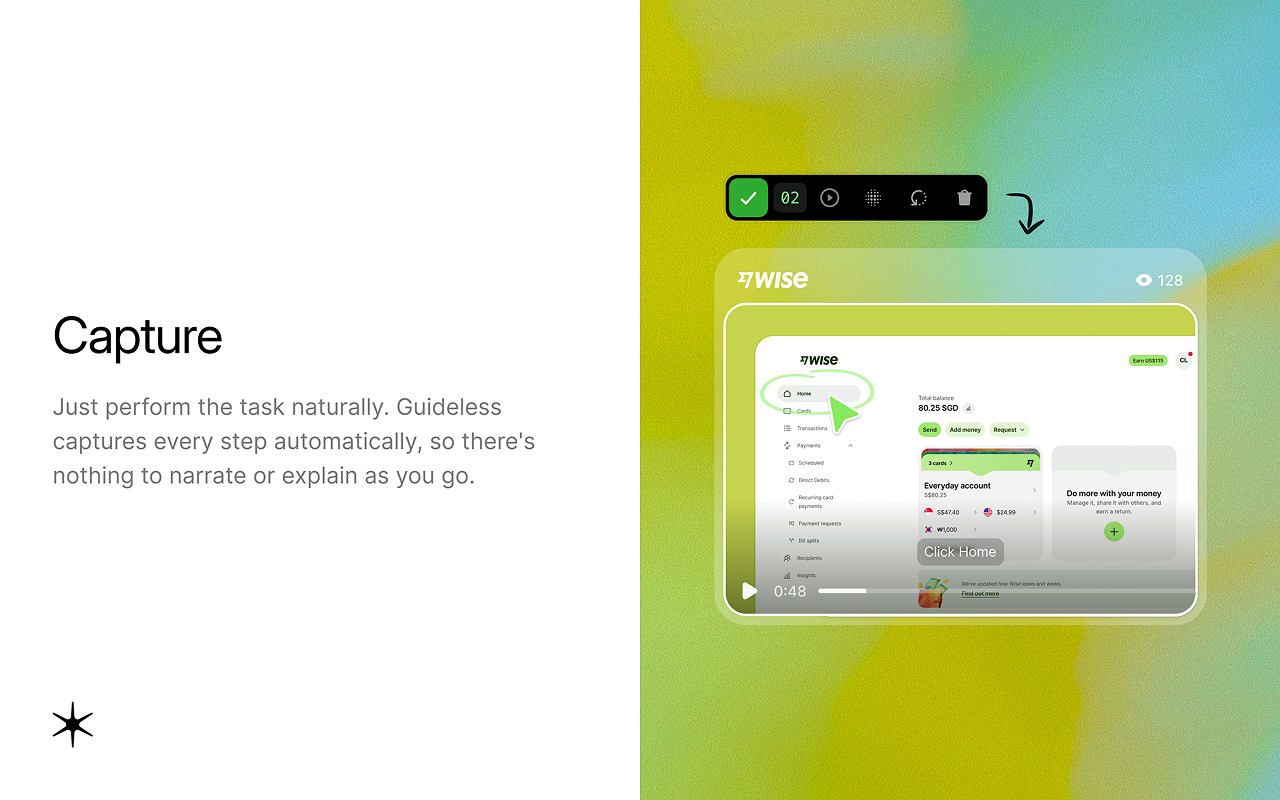
You perform the workflow once in your own systems, and Guideless adds highlights, annotations, and an AI voiceover. Voiceovers are available in 42+ languages, which helps when the same procedure applies to teams in different countries. When a system or procedure changes, you update only the steps that changed instead of recreating the whole guide.
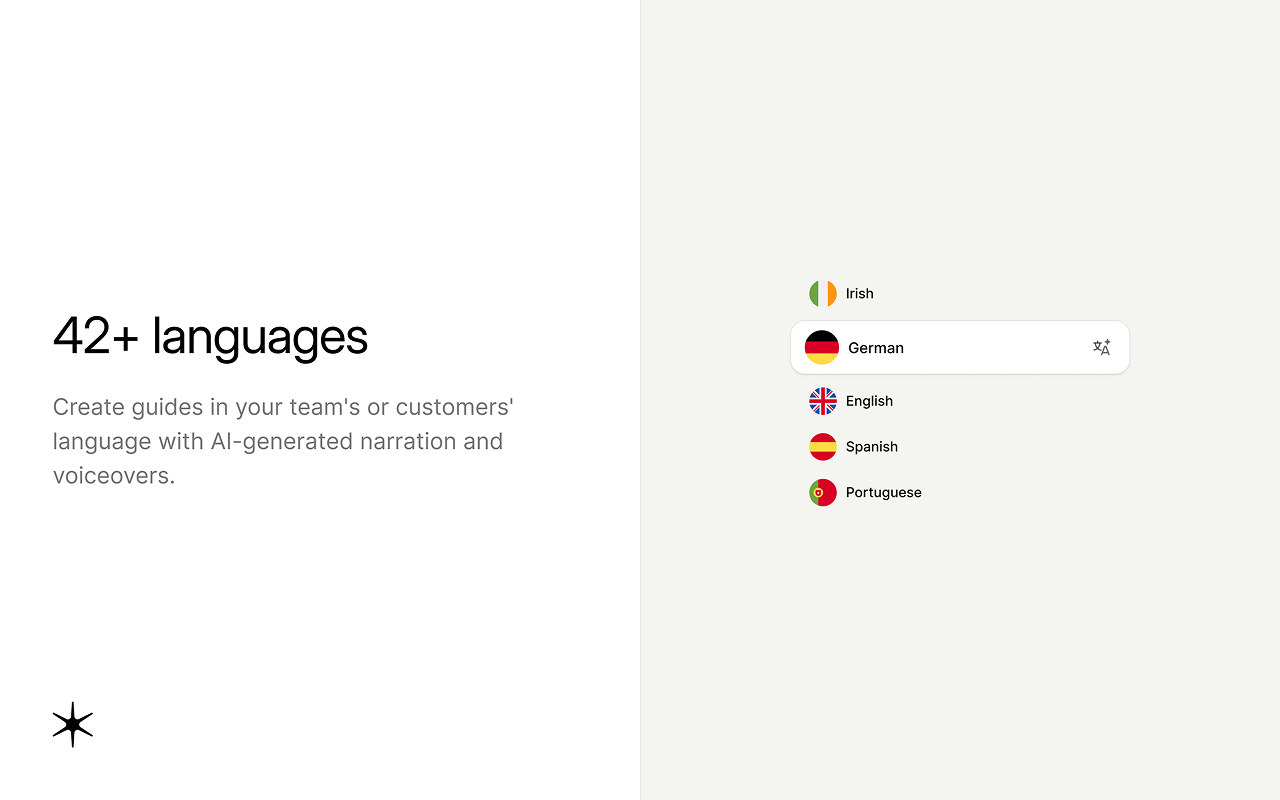
Guideless sits alongside your compliance training program rather than replacing any part of it: your learning management system still handles assignment, completion tracking, and audit records. You can share each guide by link or embed it in your LMS, intranet, or help center.
For example, this guide shows how to share a ClickUp doc and manage who can access it, the kind of access step a data protection policy refers to but rarely explains. You can browse more examples in the Guideless gallery or see how Guideless supports employee onboarding programs.