Key takeaways:
- Successful onboarding starts before day one and lasts at least 90 days to help new hires truly settle in.
- Regular check-ins at 30, 60, and 90 days help managers build trust and catch potential issues early.
- Automating basic paperwork frees up your team to focus on what actually drives retention: company culture, clarity, and relationships.
Too many companies still treat onboarding as just paperwork and a quick office tour. It leaves new hires to figure out the real work on their own, often feeling isolated instead of welcomed.
This guide helps you build a comprehensive new hire onboarding checklist covering everything from the signed offer letter to the 90-day mark. We break down why it matters, share an industry-standard framework, show you the benefits of proper onboarding, and more.
What is an employee onboarding checklist (and why it matters in 2026)?
A standard onboarding checklist maps out the exact steps to integrate a new hire, from preboarding through their first 90 days. Having a structured onboarding process in place helps your new employees become familiar with the workplace and the expectations more smoothly.
When people feel equipped and cared for from day one, there’s a good chance that your overall employee success will be higher, and that new employees will perform better. Don’t confuse this timeline, however, with standard new hire orientation. Employee orientation usually just handles first-day introductions and basic system access.
A structured process handles introductions, permissions, shadowing schedules, and more, even before they first arrive at the office, be it physical or virtual. Without this system in place, your new hires may spend their first week staring at a laptop screen and not be able to access basic systems.
The 4 Cs of onboarding - The framework behind every great checklist
The 4 Cs model is an industry standard because it helps leaders cover every practical and social aspect of a new hire joining the team.
| Compliance | Handles the paperwork, rules, and policies that keep the company legally compliant and ensure people get paid |
| Clarification | Defines the daily tasks, core expectations, and specific goals of the employee's position |
| Culture | Introduces the core values, unwritten norms, and general vibe of the company culture |
| Connection | Builds the relationships and networks new hires need to navigate the company and feel a sense of belonging |
Some teams add a fifth C, which stands for check-back or career, to maintain momentum after the first few weeks. Using this framework pushes HR teams to build checklists that actually support long-term employee growth.
Business benefits of a strong new hire onboarding checklist
A strong checklist improves key business metrics by turning a confusing first month into a clear, successful onboarding period. Research by the Brandon Hall Group, conducted for Glassdoor, found organisations with a strong onboarding process improved new hire retention by 82% and productivity by more than 70%.
First, new hires who experience a structured welcome are far more likely to stick around long-term, which boosts your overall employee retention numbers. Clear guidelines and immediate access to tools help new employees start doing real work sooner, which translates to faster productivity.
Also, proper onboarding boosts employee engagement early and directly prevents costly early departures, lowering your turnover costs. And finally, a standardized procedure ensures a fair process for everyone, regardless of who manages them, so all your new hires can get consistent and fair onboarding experiences.
Preboarding - Before the new employee's first day
Preboarding bridges the gap between the signed offer and day one, usually covering the one to three weeks before a new hire starts.
- Send a welcome email outlining first day details and sharing the team's excitement.
- Share the digital handbook and benefits package for early review.
- Send the contract, tax paperwork, and direct deposit forms to get administration out of the way.
- Start the IT setup by ordering hardware, creating accounts, and shipping company gear.
- Send a welcome package with company merchandise to build hype and motivation.
- Introduce their assigned onboarding buddy via email so they have a contact for informal questions.
Legal requirements will differ across countries and jurisdictions, but make sure you have documents that would align with these categories:
- Employment contract and written terms. Most countries require contractual work terms (role, place of work, pay, hours, notice period, probation) in writing with a set window after or even before the start date.
- Right to work and identity verification. More applicable to cross-border or remote hires, but every employee has to be legally permitted to work in the country the role sits in.
- Tax registration. Almost every country will require a business to register a new employee with the relevant tax authority and collect the withholding declaration your payroll system needs before the first pay run.
- Social security and mandatory insurance. Many countries require registration with a social security, pension, or health insurance body, in some cases before the first working day.
- Health, safety, and mandatory training. Most employment frameworks require a safety induction at the start of the role, and mandatory training is generally the employer's cost, not the employee's.
Build these requirements as hard gates, not nice-to-haves within your checklists. Most of these have hard deadlines that have to be met to stay within the legal framework of a country.
Day one - first-day onboarding checklist
A great first day sets a positive tone and confirms for the new hire that they made the right choice.
| Time | Activity |
| 9:00 - 10:00 | Coffee chat with manager and office tour |
| 10:00 - 11:30 | IT login and hardware setup |
| 11:30 - 12:30 | Orientation covering company mission, company culture, and basic benefits |
| 12:30 - 13:30 | Welcome lunch with the team |
| 13:30 - 15:00 | Introduction to core communication and software tools |
| 15:00 - 16:30 | First week goals review with manager |
| 16:30 - 17:00 | Wrap up and early dismissal |
Assign an experienced buddy to check in daily for the first two weeks. They provide a safe space for informal questions new hires might hesitate to ask a manager.
First week - integrating new employees into the team
The first week transitions a new hire from observation to action. They should start tackling small tasks while continuing to learn the business during employee training sessions.
- Tuesday. Grant team channel access and review the department's current projects.
- Wednesday. Hold a role clarity meeting to define exact expectations for the first month.
- Thursday. Start training them for the job gradually and have the new hire shadow a peer on a core task.
- Friday. Introduce relevant employee resource groups to help them build their internal network.
Schedule a Friday morning debrief between the manager and the new hire to answer questions and set goals for the upcoming month.
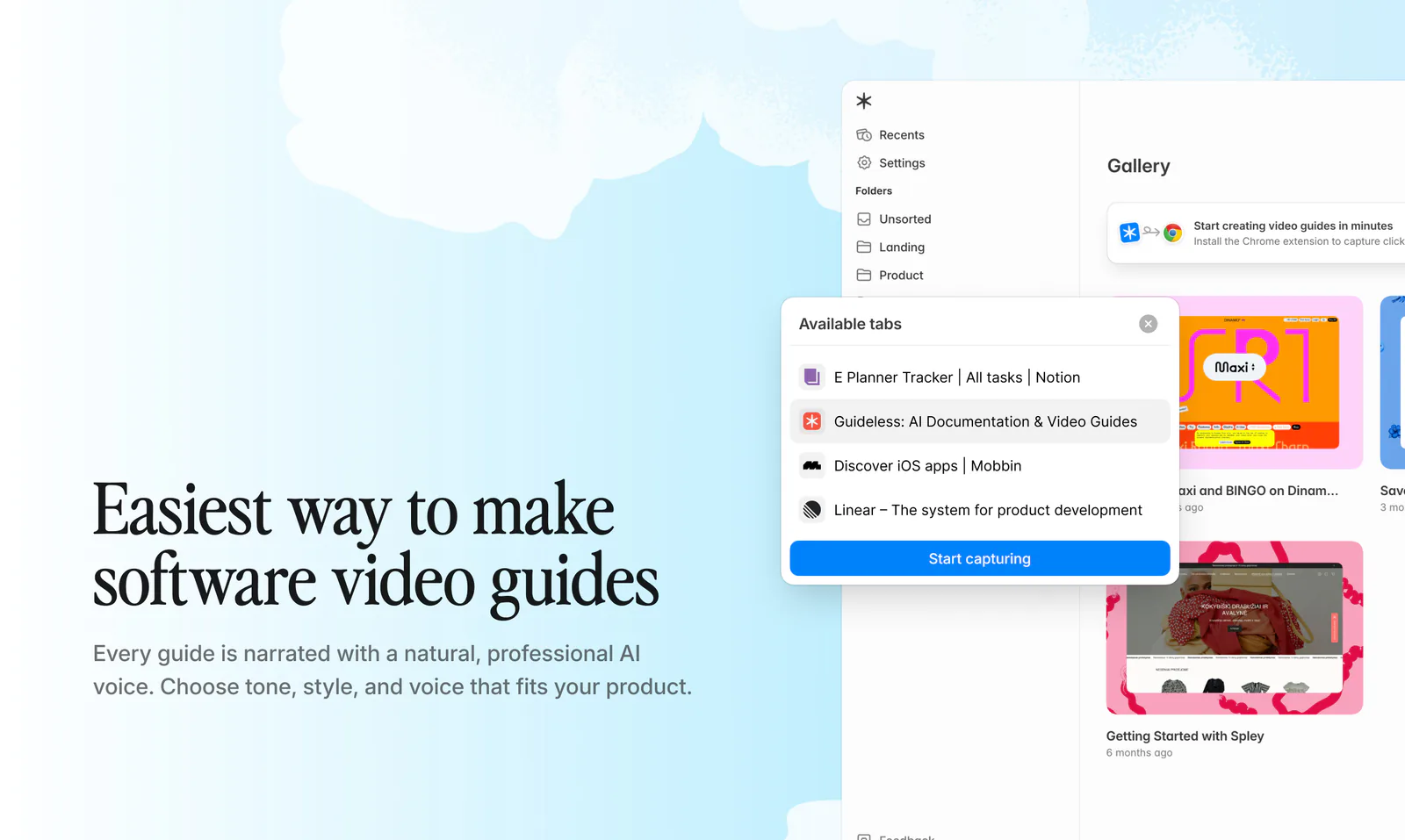
If your business runs on tools that are hard to grasp at first glance, a platform like Guideless can automate the software training layer. You click through the workflow once in your browser, and it builds a polished, AI-narrated video guide in minutes: no screen recording, no editing, and you don't even need to talk.
Tools like Guideless are incredibly helpful when new hires need to master internal systems such as custom CRMs or ticketing platforms.
First month to 90 days - deepening skills and measuring progress
The 30-60-90 framework gives managers and new hires a clear roadmap to track progress, catch early challenges, and guide the employee toward full independence.
By the end of month one, the new hire should handle their daily tasks comfortably and start building trust with their team.
After two months, the employee should tackle larger projects with less supervision. HR also steps in here to establish regular feedback sessions, starting with a formal review to see how the new hire is settling in.
The three-month mark is a major transition. Managers should use this time to review overall performance and start discussing long-term career goals and professional development.
30-60-90 day check-in questions for new hires
30-day questions
- What feels unclear about your role?
- Which tools have been hardest to learn?
60-day questions
- Are you getting the support you expected?
- What's slowing you down?
90-day questions
- Where do you want to grow?
- What would you change about the onboarding process?
Treat these as genuine conversations, not a checkbox exercise. If a new hire senses you're working through a form, you'll get the answers they think you want rather than the ones you need.
Adapting the checklist for remote onboarding, hybrid, and onsite roles
A single standard approach does not work. Remote employees logging in from three time zones away need a completely different experience than someone walking into headquarters.
- Remote. Managers need to lean on onboarding software for remote teams and intentionally schedule virtual coffee chats to make up for missing hallway conversations.
- Hybrid. Schedule complex or highly collaborative training for the exact days the new hire is in the office.
- Onsite. Prioritize facility tours, safety protocols, and in-person shadowing.
Make sure remote employees and hybrid workers receive invitations to the same orientation sessions and social events as your onsite team.
Tools, templates, and automation for employee onboarding
It can be useful to leverage specialized new hire onboarding software that can produce an active workflow that reminds people exactly when they need to step in.
- Set up a welcome email template that sends automatically when a candidate accepts an offer.
- Create an IT checklist that routes hardware and software requests straight to the tech team.
- Set up an automated 30-day survey to gather early onboarding feedback regarding the employee's experience.
Keep basic administrative tasks like tax forms and benefits enrollment separate from the actual training modules that teach the job.
Maintaining and improving your new hire onboarding checklist over time
Treat your onboarding checklist as a work in progress. HR and hiring managers should audit it twice a year to update software links and apply recent feedback.
For example, you may want to track 90-day turnover rates to catch spikes in early departures, measure how long it takes for a new hire to finish their first independent task, monitor internal surveys to track overall morale, and analyze your onboarding dashboard to spot bottlenecks and find where the process gets stuck.
Frequently asked questions
How long should an employee onboarding program last?
A thorough program should run for at least 90 days, as it gives people enough time to learn the core work and build relationships. Some teams might even stretch this to a full year to allow time to master complex systems.
What's the difference between a pre-hire checklist and an onboarding checklist?
A pre-hire checklist tracks recruitment steps like sourcing candidates, interviewing, and finalizing the offer. An onboarding checklist takes over after the candidate signs the contract.
Who is responsible for owning the onboarding checklist - HR, the hiring manager, or both?
Human resources generally builds the broad framework for legal paperwork and company-wide benefits. The direct manager fills in the specific milestones that teach the daily tasks. But both sides must do their part well and communicate properly. Otherwise, new hires fall through the cracks because HR assumes the manager explained a process and vice versa.
How do we measure whether our onboarding checklist is working?
You can evaluate your onboarding process by looking closely at a few specific milestones.
- First-year retention rates highlight structural flaws that push people out.
- The time it takes to complete an independent project reveals if your training actually works.
- Feedback from the 90-day review exposes hidden frustrations managers often miss.
- Combining these hard metrics with honest conversations shows exactly where your system succeeds and where it breaks.
Do small businesses need the same onboarding checklist as large companies?
Yes. While a smaller business might skip expensive automation software, they still need a structured plan. The scale changes, but the basic need for clear direction stays the same.
How often should we update our onboarding checklist?
Review your onboarding materials at least twice a year. If you wait too long to refresh your documents and links, new hires are likely to land on outdated login screens, which stalls their progress and forces them to track down managers just to get the right information.