Most B2B SaaS companies lose customers before those customers ever see real value. Not months later, when a renewal conversation goes sideways. In the first 90 days, quietly, during onboarding.
That's the part that gets missed. Churn doesn't usually look like a customer suddenly deciding your product isn't worth it. It looks like a customer who never fully got started, who hit friction early, who kept meaning to finish setup and never did. Rocketlane's research on B2B onboarding found that 63 percent of customers say the quality of onboarding influences whether they stay with a company.
This guide covers the onboarding practices that actually move the needle, not the ones that look good on a slide but don't change outcomes. If you're building or fixing a B2B onboarding process, start here.
What B2B customer onboarding actually means (and why it's harder than B2C)
B2B customer onboarding is the process of getting a new customer from "contract signed" to consistently using your product in a way that delivers the outcome they bought it for.
That sounds close to consumer onboarding, but the mechanics are different. A B2C signup usually involves one person making one decision. A B2B deal usually involves a buyer, a handful of end users, sometimes an IT or security stakeholder, and a champion who has to justify the purchase internally. Each of those people needs something different from onboarding, and if any of them gets left behind, adoption stalls.
It also helps to separate two things that get bundled together constantly: onboarding and implementation. Implementation is the technical work, integrations, data migration, configuration. Onboarding is the human side, making sure people understand what to do and why. A technically flawless implementation can still fail if nobody on the customer's team actually knows how to use the product day to day.
Why onboarding is where B2B SaaS churn actually happens
Onboarding is a high-risk window because it's the gap between "we bought this" and "we actually use this." Customers who don't cross that gap quickly are the ones who churn, often before renewal even becomes a conversation. Research on B2B SaaS churn patterns puts a rough number on it: 15 to 25 percent of annual churn traces back to onboarding issues in the first 90 days alone.
The metric that predicts this better than almost anything else is time to value, or TTV: how long it takes a customer to reach a genuinely useful outcome, not just log in or complete a setup wizard. Teams that treat TTV as a number worth tracking tend to catch stalled onboarding early. Teams that don't usually find out something went wrong when the customer stops responding to emails.
9 B2B customer onboarding best practices
1. Define what "value" means for each customer before kickoff
Every customer bought your product to solve a specific problem, and that problem isn't identical across accounts. A generic onboarding checklist treats a finance team automating reconciliations the same way it treats a sales team trying to shorten deal cycles. That's a mistake.
Before kickoff, get specific: what does this customer need to be able to do, by when, for the deal to feel like a win on their side? Build the onboarding plan around that outcome, not around a standard list of setup tasks.
2. Get sales-to-CS handoff right
A lot of onboarding friction is self-inflicted. The sales team learns everything about a customer's situation during the deal, then none of that context makes it to the person actually running onboarding. The customer ends up repeating themselves, and the onboarding team starts from zero.
Document the handoff: what was promised, what the customer's technical environment looks like, who the key stakeholders are, what "success" was defined as during the sales process. This isn't extra paperwork. It's the difference between onboarding that feels informed and onboarding that feels like starting over.
3. Build a repeatable playbook, not a one-off plan per account
Improvising onboarding for every new customer doesn't scale, and it produces inconsistent outcomes depending on who happens to be running the account. A playbook fixes this: standard milestones, standard timelines, standard resources, with room left for the specifics that make each customer's situation different.
The goal isn't to make onboarding rigid. It's to make the 80% that's common across customers repeatable, so your team's time goes into the 20% that actually needs judgment.
4. Shorten time to first value deliberately
Time to value isn't something that just happens faster if you work harder. It's something you design for. That usually means resisting the urge to onboard customers into the full breadth of your product on day one, and instead getting them to one meaningful win as fast as possible.
A small, fast result, a report generated, a workflow completed, a first integration live, builds confidence and momentum. A comprehensive but slow rollout does the opposite, even if it's technically more thorough.
5. Replace repetitive live calls with reusable content
This is where most onboarding time actually goes, and it's the least efficient part of the process. CS teams end up re-explaining the same account setup, the same configuration steps, the same feature basics, on call after call, to different customers who all need the same information.
The fix isn't fewer calls for the sake of it. It's moving anything repeatable out of live calls and into content customers can follow on their own schedule: step-by-step guides, short walkthroughs, embedded help. Calls stay reserved for the parts of onboarding that genuinely need a conversation, strategy, edge cases, troubleshooting. Everything else becomes self-serve.
6. Personalize by role, not just by account
Onboarding often gets personalized at the account level and stops there. But an admin setting up permissions, an end user learning daily workflows, and an executive sponsor who wants to see ROI all need different content, delivered differently.
Sending everyone the same onboarding sequence means most of it is irrelevant to most people. Segmenting by role, even simply, admin track, end-user track, sponsor track, makes onboarding feel relevant instead of generic.
7. Communicate proactively, not just when asked
Customers who go quiet during onboarding aren't necessarily fine. Silence is often a sign of confusion or stalled progress, not satisfaction. Waiting for the customer to reach out with a problem means you find out about it late, sometimes too late.
Regular, short check-ins, and visibility into where the customer actually stands in the process, catch problems while they're still small. This doesn't need to be heavy. A brief status update or a quick nudge at a natural milestone is usually enough.
8. Track onboarding metrics and act on them
Time to first value, completion rate, drop-off points, early engagement. These aren't vanity numbers. They're the earliest signal you'll get that onboarding is or isn't working, well before churn shows up in a renewal report.
The important part is acting on them. A guide with a lot of views but a low completion rate is telling you something specific, that the content is too long, unclear, or not actually relevant at that step. Tracking without acting on the data is just dashboard decoration.
9. Hand off cleanly from onboarding to ongoing customer success
Onboarding has to end at some point, but the transition to ongoing CS is where a lot of accounts quietly lose momentum. If ownership isn't clear, or if the customer suddenly goes from close support to radio silence, the goodwill built during onboarding erodes fast.
Define what "done" looks like for onboarding, and make sure the customer knows who they're working with next and what that relationship looks like. A clean handoff protects everything the onboarding phase built.
Common B2B onboarding mistakes to avoid
Treating onboarding as one-size-fits-all. Different customers, different roles, and different goals all need different paths. A single generic sequence will underserve most of them.
No clear owner between sales, onboarding, and CS. When responsibility is vague, things fall through the cracks, and customers notice.
Relying entirely on live calls and PDFs that go stale. Calls don't scale, and static documents drift out of date the moment your product changes.
Not measuring anything until churn shows up. By the time churn is visible, the problem started months earlier, usually during onboarding.
How AI is changing B2B customer onboarding
The shift underway in B2B onboarding is fairly simple: manual, one-to-one methods, live calls, screen shares, static PDFs, are being replaced by content that's created once and reused at scale, and that stays current without constant manual upkeep.
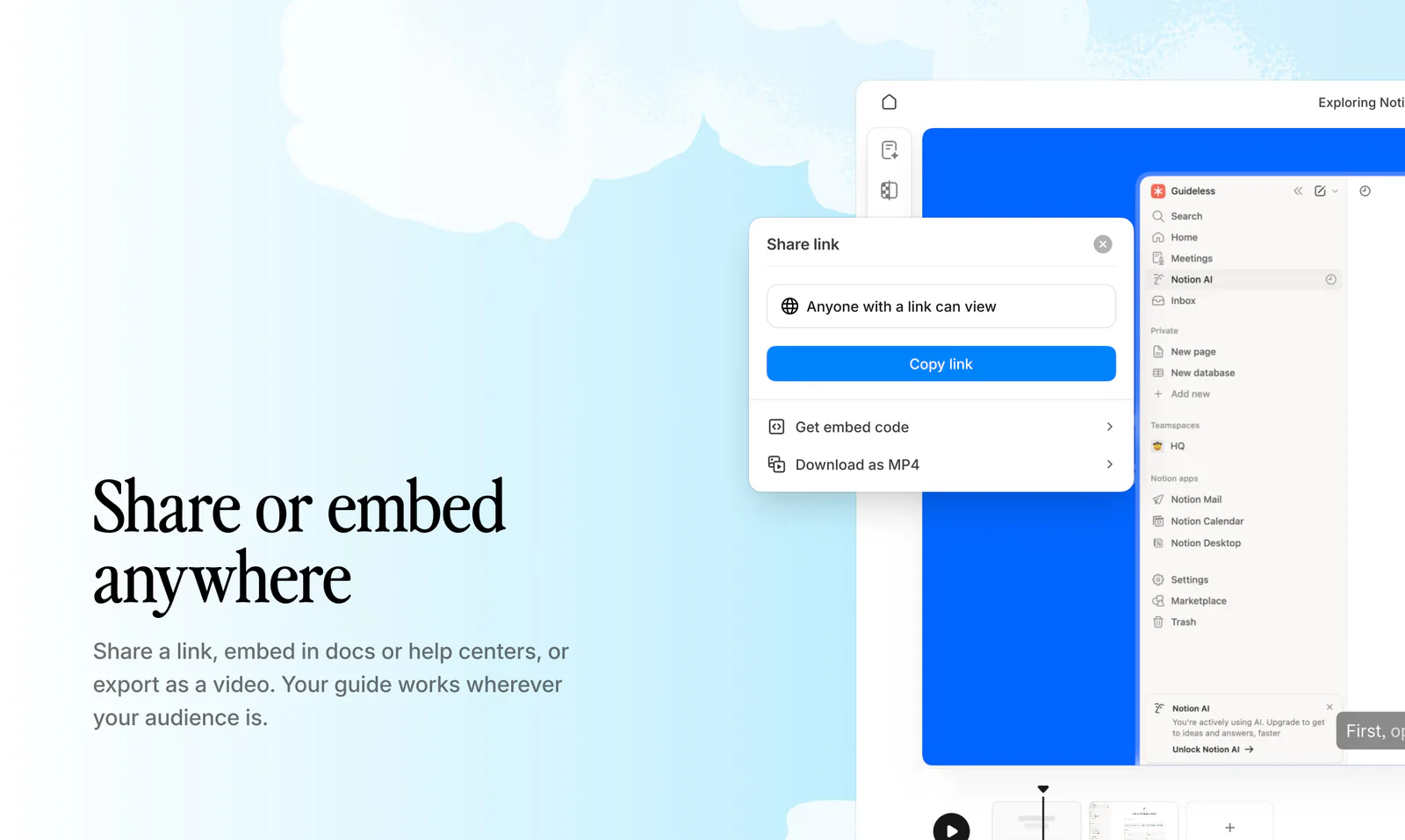
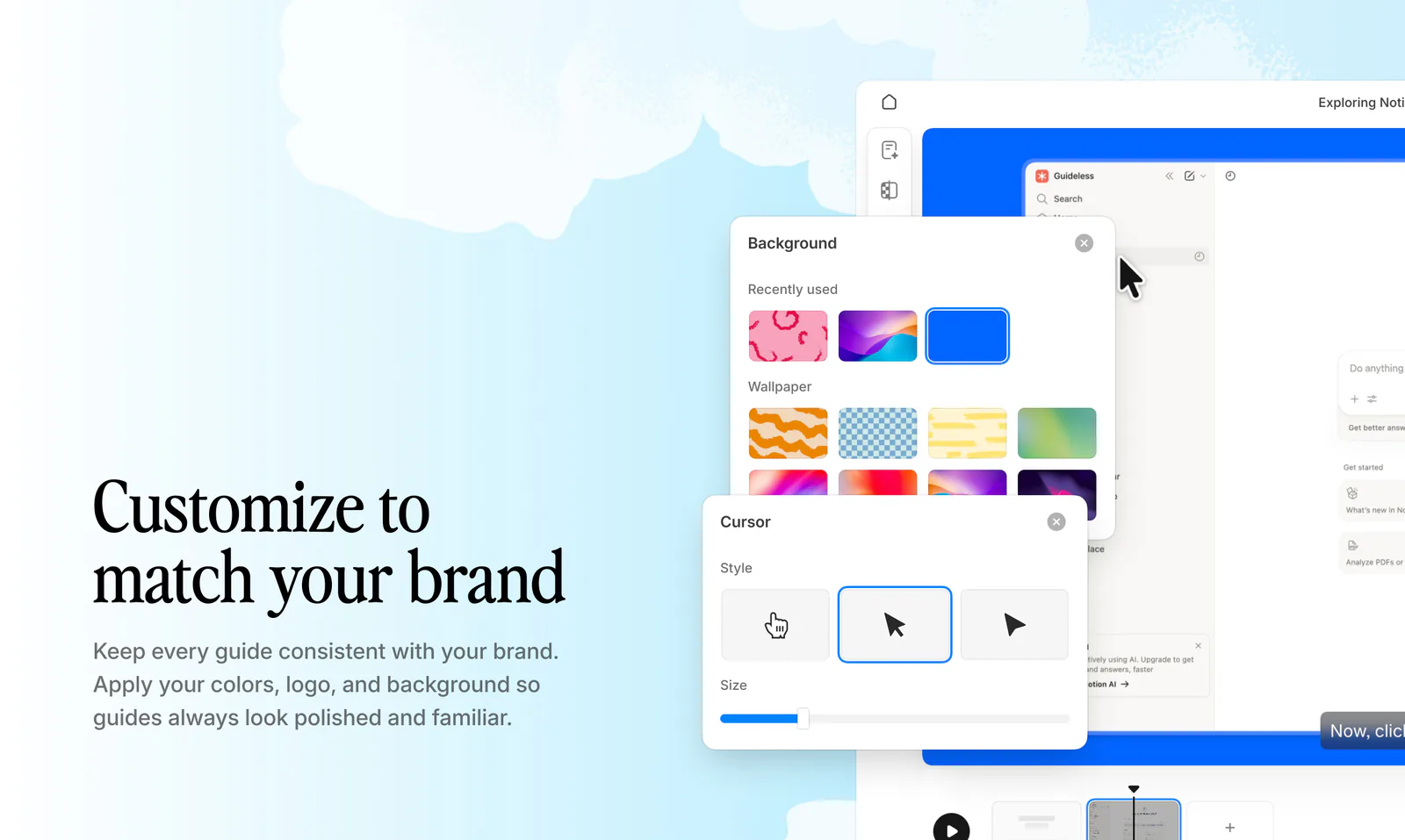
Tools like Guideless let teams capture a real workflow once and turn it into a narrated, step-by-step guide that customers can follow on their own, without waiting for a call. For teams that need a deeper look at how AI-narrated guides fit into a broader CS motion, our piece on AI-narrated onboarding guides covers that in more depth.
B2B onboarding checklist
A shorter version of the practices above, for quick reference:
- Define the customer's specific desired outcome before kickoff
- Document context from sales before onboarding starts
- Use a repeatable playbook with room for personalization
- Identify the fastest realistic path to first value
- Move repeatable explanations out of live calls and into reusable guides
- Segment onboarding content by role, not just by account
- Check in proactively rather than waiting for customers to ask
- Track time to value, completion rate, and drop-off points
- Define what "done" looks like and hand off clearly to CS
- Keep onboarding content up to date as your product changes, not just at launch